
Rapid Flash Test System
High-speed automated platform for flash component testing, designed for consistent quality and repeatable operation.
Operators place the tray with components on the left workstation and press the start button. Components are picked by the suction nozzle, placed onto the test fixture for inspection, and separated into good and defective parts. This cycle repeats until the tray is fully processed. After completion, operators remove the tray and replace it with a new one for the next batch.
Test software, mainboard, and test fixtures are provided by the client. The system supports fully automated operation and can be customized according to customer requirements.
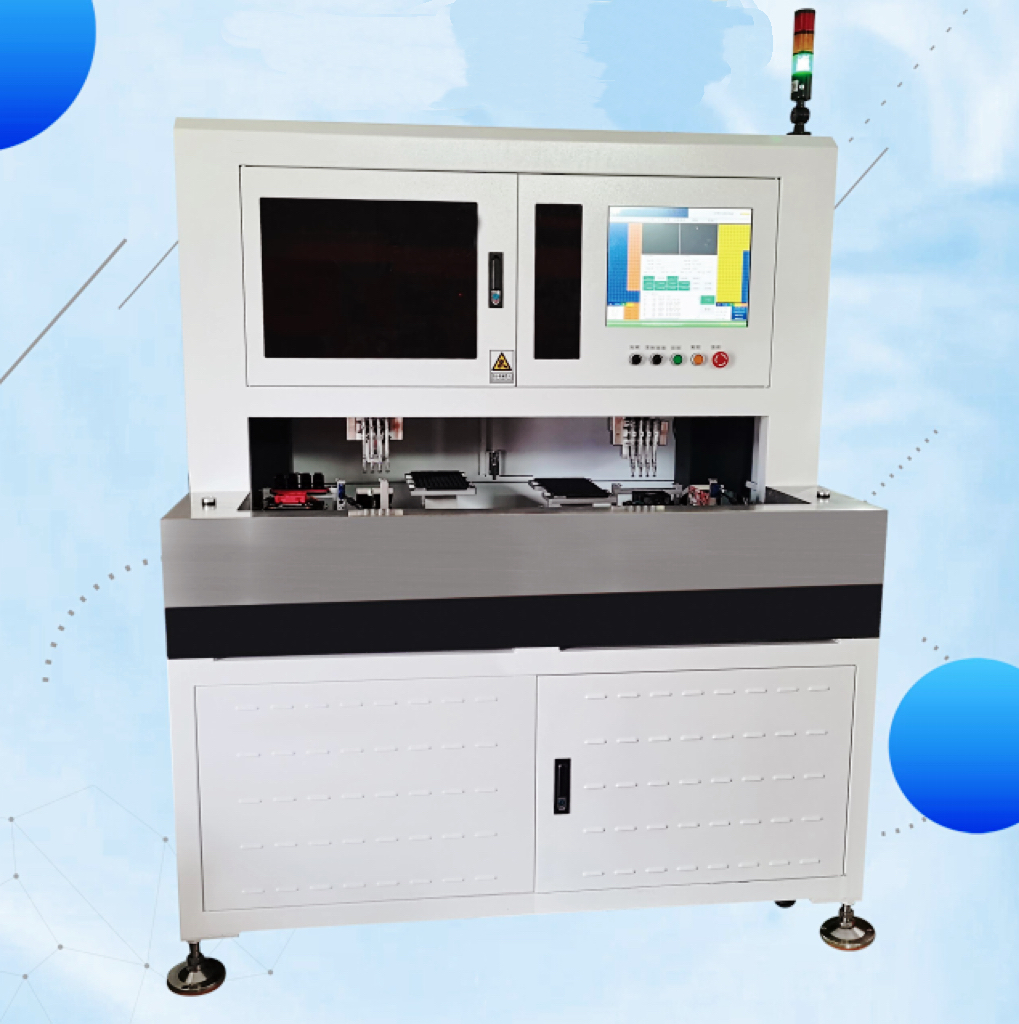
System Overview
The Rapid Flash Test System automates tray handling, component testing, and defect separation. Components are picked from the tray, tested on the fixture, and good parts are returned to the tray while defective ones are removed. This process repeats until the tray is fully processed.
The system is fully systemized for repeatability, reliability, and high-speed operation, ensuring consistent test results.
Key System Features
- Automated flash component testing with tray handling
- Suction-based pick and place for accurate positioning
- Defective component removal and good component placement
- Fully systemized operation for repeatability and reliability
- Customizable according to specific customer requirements
- Supports client-provided test software and fixtures
Technical Specifications
| Machine Dimensions (L × W × H) | 1500 × 1000 × 1800 mm |
| Motion System | Servo motors, stepper motors, precision linear modules |
| Control Platform | Panasonic PLC with Weinview HMI |
| Vision System | CCD for component orientation and defect detection |
| Electrical Components | Mean Well DC power, CHINT safety devices, AC contactors |
| Mechanical Parts | Ball screw modules, in-house machined parts, custom tooling trays |
Engineering Philosophy
Designed for speed, reliability, and repeatability, this system automates rapid flash testing to improve production efficiency and reduce manual handling.
Modular design and standardized components allow easy maintenance and system customization to meet different customer production requirements.